Driving across the Biloxi-Ocean Springs bridge last night, it took me a moment to realize the street lamps were out. This new bridge is beautiful both from its peak, overlooking Back Bay Biloxi, and from the shore of the Mississippi Sound, our stunning span of nature, protected by barrier islands from the greater Gulf of Mexico.
The magnetic darkness reminded me. I know what nighttime in Japan looks like right now. I know the silence. I recognize the unnerving forever they face.
Years passed after Hurricane Katrina before the bridge reopened. Our connection between Biloxi and Ocean Springs, destroyed. So much of our infrastructure completely demolished along the sleepy lengths of the Gulf Coast. No street lights. Not for years.
Losing your home is one thing. Losing your connections to your own communities is a slap in the face.
Everything you call home, either gone, unrecognizable, or out of reach.
Today, the bridge is more gorgeous than it ever could have been without Hurricane Katrina. Much of the Gulf Coast can say the same. We recovered. We are recovering.
subscribers click through for video by VisitMSCoast
Briefly passing into darkness as I reached the summit of our bridge was an echo of what Japan is suffering in the aftermath of their recent earthquakes and tsunamis. A diminished echo.
We can not compare our nation’s natural disasters to Japan’s. But our heart hears the echo, feels it reverberate, moves us to action.
New Orleans will reverberate with echoes of Japan and natural disasters nationwide this Saturday night as I join Tide Loads of Hope at Mom 2.0 Summit, so close to my old home in New Orleans and home now in Gulfport, for a rogue after-conference reading called Tide Stories of Hope. Readers and witnesses will stand together and dedicate astonishingly personal stories of hope, drawing direct lines from ourselves to those in Japan, unearthing very few degrees of separation between.
Every time I share my connection to Tide Loads of Hope with you, I am inviting you to close your eyes, take a deep breath, and feel your own connection reverberate. This is more than a story of a corporation providing free laundry services to natural disaster victims. This is more than a story of a big orange truck, a mobile laundry-mat spinning suds into dignity.
We are all at the will of nature. None of us are immune to natural disasters. This is your story as much as it has ever been mine.
Tide Stories of Hope
Saturday night 8-10pm CT Join us in person in New Orleans at the Eiffel Society Uptown or join us via #Mom2Summit or #TideHope on twitter.
From Mom 2.0 Summit:
The evening’s readers - Heather Armstrong, Alice Bradley, Doug French, Liz Gumbinner, Megan Jordan, Eden Kennedy, Jenny Lawson, Maggie Mason, Stacy Morrison, Kyran Pittman, and Ron Mattocks - will each read one of their “stories of hope” in dedication to someone they’re connected to, either directly or through six degrees of separation, who has faced a natural disaster.
Text “RedCross” to 90999 to automatically donate $10 to relief efforts. I never thought I would know the surge of relief that seeing a Red Cross truck can evoke, but I do.
• • • • • • • • •
I stand at the summit of hope and share my stories with you. I invite you in to know me so that I may know you, laugh at our follies, shake our heads in disbelief, cry at humanity shaken to its core, and summon our communal strength to continue to move forward. We are in this together. We always have been.
Exhaustion finally caught up with me. Little sleep thanks to round-the-clock nursing of a daughter that saves me from bitterness with her midnight smile alone, two handsy boys in pre-K and elementary school, and a tendency to play a stay-at-home martyr who takes care of herself last, all added up to what felt like the flu this week.
Risking even a glance at a computer when I’m feeling like that is risking a visceral “oh, screw it all” response and going Social Media Cold Turkey for months. Liken it to those completely irrational middle-of-the-night thoughts that escalate problems into disasters, which the light of the morning dissipates back into minor complications. When I’m feeling sick, I tend to feel overwhelmed and dismissive.
The last couple of weeks have left me feeling vulnerable to dismissing my interest in social media because of one feeling in particular: Compassion fatigue.
My thanks to Deb on the Rocks for reminding me of this phrase during a recent trip. A turn of phrase I had become so used to hearing when I worked in mental health, but one that had been long filed and forgotten from a blissful lack of relevance to my life. It’s relevant again, and not just to me.
Haiti is collapsing. California is flooding. Mothers are losing their children. Children are losing their fathers. Societal and familial infrastructures seem so fragile that helping feels like the ineffectual paper towel in a hurricane.
As traditional and social media shrinks our world down to the size of a BlackBerry screen, we are inundated with suffering. A day without disaster is notable in and of itself. Matt Lauer talking travel tips seems almost offensively naive. Surely there is a tragic story that could better use The Today Show’s valuable airtime?
I’m shaking my head. Give me trivial travel tips about Greece. Please. I’ve had enough. I need carefully coiffed hair and whitened smiles on my screen for a breather.
Journalism analysts argue that the media has caused widespread compassion fatigue in society by saturating newspapers and news shows with decontextualized images and stories of suffering. This has caused the public to become cynical, or become resistant to helping people who are suffering…
Compassion fatigue can be seen in the resistance of the general public to give money to charity or other good causes due to overexposure… "Overexposure" in this context refers to the repeated solicitation of donations or voluntary efforts from civilians by charitable agencies, often triggered by natural disasters, or disasters of a large scale. Some people become frustrated by constantly being solicited for donations...
“Overexposure” is an understatement. In social media networking alone, we are saturated with calls for help. $5 here for a sick kid, $10 there for breast cancer research, “Donations for Comments!” and challenges to our moral compass if we don’t publicly declare our support, either financially or via our time and energy.
It’s enough to make you want to turn off the computer. Ahem.
Good grief. Even I’m tired of hearing myself say that.
I understand the desire to help. Even more so, I understand the desire to do something. That is, in fact, why I lend my financial support and energy to the Red Cross and Loads of Hope, respectively. I’ve seen what they do.
I’ve seen what your Red Cross donations do first hand. I’ve accepted help from the Red Cross and I know what it feels like to see their red cross emblazoned white truck approach your street after a natural disaster.
Likewise, I’ve stood in front of families that have shoved their pride into their pockets long enough to let Tide wash their clothes at the Loads of Hope truck. I’ve watched those families circle the truck, trying to decide if they will stop or not. I’ve seen them approach the staff, empty-handed, ask very off-handedly “Soooo, what’s going on here?” as though they were just passing by, and then just so happen to have loads of dirty clothes in their car.
Asking for help can be difficult. Accepting help can be immensely difficult.
For three days in New Orleans this December, I worked alongside Mishelle from Secret Agent Mama and Deb on the Rocks and watched the Loads of Hope staff diffuse the shame and anger and pain associated with need. With deft hands, they unburdened families of that need, if only for a week’s worth of clean clothes.
I know you want to do something rather than just give. I think that’s why so many of you spent your time participating in our Loads of Hope for the Holidays campaign sponsored by Tide via Blog Nosh Magazine and Velveteen Mind this December. For your time, energy and heartfelt commitment, I am endlessly grateful. Your generosity warmed me as I stood in the New Orleans rain and watched the results of your contributions wash away the edge of need.
And yet, even among people that are well-versed in compassion and empathy, I faced down compassion fatigue in New Orleans. It was the glazed look among local volunteers when I assured them that I had suffered loss in Hurricane Katrina and wasn’t merely a sensationalist looking for a story. It was the absent nod among hurricane survivors, accompanied by a mumbled, “Yeah, everyone lost everything.” because we’ve heard it all before.
It was then that I pulled out my big gun. It was then that I did the one thing that I knew would snap them out of their mile-long stare: I played my victim card. Literally. In response to their “I’ve heard this story before” expression, I would hand them this:
My victim card. It’s a dirty one. I don’t play it often, mostly just when I’m writing about a cause here, but when I play, I play for keeps.
And they would snap out of it. Their eyes would focus and they would meet my gaze with an entirely different level of commitment. They would remember that this threadworn story is more than platitudes and exaggerations designed to win sympathy and crack open your wallet. They would snap out of the fog of compassion fatigue.
This is where I insert my well-heard “And that is why I lend my support to the American Red Cross and Tide’s Loads of Hope program!” And by God, I want for you to hear me. Let me be your surrogate to knowing that your compassion is delivered by practiced hand by these organizations.
Do you want to do something? Do you want to help, sure, but can’t shake the longing to see your efforts transform directly into deliverance? I understand this. In the pit of my stomach, I promise you, I understand.
But that’s not always how need works.
Donate $10 to the Red Cross to help Haiti. Buy a Loads of Hope t-shirt so that Tide can continue to spin laundry detergent into dignity. Whatever makes sense to you. No, it may not be appropriate for you to lift a piece of rubble in person or load a washer yourself right now, but your support makes those efforts possible on a much broader scale than your own physical presence can.
Don't Go To Haiti - Good Intentions Are Not Enough (1-27-10 update: found this link via Sally Lee, Editorial Director of Meredith publishing group. covers the logistical side of my emotional argument.)
Razor wire used to lace along the length of the Mississippi Gulf Coast. Two blocks north of the beach, along the railroad tracks where the earth rises just enough to slow the rush of surging water, coils of sharp wire kept those of us north of the tracks from entering the wasteland south of the tracks. Where the debris towered. Where houses not cleaned to the slab teetered.
Where the bodies were.
It is amazing what the human psyche can grow accustomed to, given enough time and torture. Or perhaps you only allow yourself to get used to it when that time and torture is laced with razor-sharp hope. You know it will be over some day. So you keep moving. And you try not to wonder too much about what is south of the tracks.
Four years ago, I would have given anything to know what awaited me south of the tracks. Little did I know that I had nothing left to give. At least nothing that once nestled south of those tracks.
The warmly lit, thoughtfully adorned space that I called my home was reduced to a slab of concrete four years ago. Hurricane Katrina made landfall along the Mississippi Gulf Coast on August 29, 2005. We received the strongest winds of the eastern eye wall, typically the most dangerous quadrant of a hurricane. As such, the Gulf Coast was the favored spot for storm chasers.
There is not a plethora of “Al Roker hanging onto a tree” news footage of Katrina hitting Biloxi and Gulfport and Long Beach and Pass Christian and Bay St. Louis and Waveland… because a “white out” occurred. In short, the wind and rain were so strong that you couldn’t see beyond a few feet.
Then the waves came.
Unlike New Orleans where the beautiful bowl of the city, the city I had just moved away from, filled up with water and then eventually emptied, leaving ruined structures behind, the Mississippi Gulf Coast was simply wiped clean for miles and miles. Nothing to see here, folks. Just empty slabs.
I do remember saying, over and over, “Please God, if it’s gone, let it all be gone. Don’t leave me with a ruined home that needs to be sifted through. Just take it all.” I couldn’t bear the choices that would have to be made. The fruitless efforts to save… anything.
And so it was.
A million times over, in the days after Katrina, we heard, “I lost everything.” But so often, what they meant was that they lost everything in their attic or garage or master bedroom. Once, when pressed, I discovered that they meant everything in their refrigerator.
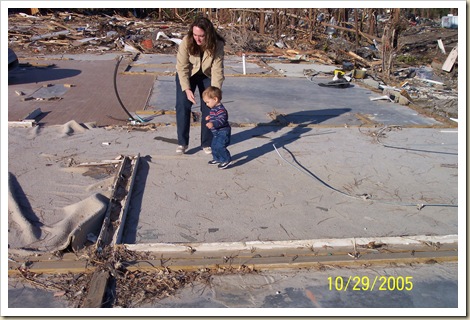
I can write a million times, “We lost everything.” It is only when I share the picture above that it seems to sink in.
Everything.
Everything you could touch. Save our lives.
It is impressive, isn’t it? Seeing what “everything” looks like when it’s gone.
But you could lose “everything” in a fire. What was frightening was the greater stretches that “everything” encompassed.
We lost all of our touchstones. All of our points of refuge, sources of hope. All of the things that you call “home” outside of your home.
We lost our schools. Libraries. Public utilities. Fire departments. Police stations. Hospitals. Pharmacies. Grocery stores. Restaurants. Bookstores. Piers. Bridges. Roads. Water. Sewer. Phone. Power.
We lost our freedom. It was martial law. Literally.
Dusk to dawn was a no-man’s land of curfews and military patrols. The sound of a generator in the middle of the night was a red flag. It meant you had gasoline. So few people had gasoline. So many wanted it.
Cold hard cash was bested by ice. Beer was liquid gold.
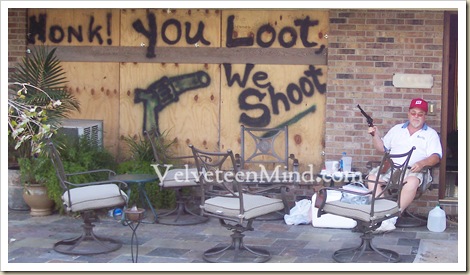
Hotlines were established to quell rumors of looting and other Carnival-of-Danger worries. Hotlines which were helpful to call… if you had a satellite phone. Otherwise, you created “watch” schedules and spray painted your house with subtle warnings.
Or not-so-subtle warnings.
That picture of my dad at my parents’ home two miles inland (yes, that’s my dad) makes me smile today. Truth be told, it made me smile when I took it. We recognized the absurdity of it, knew the hope that this would be an entertaining story one day, and simultaneously released all qualms about sitting on the front porch with a loaded gun in the middle of the day in the middle of a middle class neighborhood.
Because when you are in the middle of it, you would be amazed at that to which you can become accustomed. If you hope to come out on the other end of the storm with more than a slab of a spirit, you learn to stop fighting the surges. You learn to let hope be the rock around which you sway and bend in the wind.
Today, I drive over the railroad tracks daily as I head toward the beach to take Goose to school. I had to take an alternate route the other day and passed through an intersection that used to be a military checkpoint in the weeks after Katrina. While buildings were being secured and the debris line was being removed, that point along the coast at which the waves stopped crashing and simply pushed all of our lives into one long mass of memories, only certain people were allowed across the tracks.
Those that virtually called “bring out your dead” and those that cleaned up behind.
It reminded me of how near-complacent I became about the military presence in those days. Humvees patrolling our neighborhood. Helicopters constantly buzzing overhead. Expected and unexpected military checkpoints, depending on what was discovered under the debris that day.
How complacent we all eventually became about so much.
It was complacency that allowed us to lose so much. We had evacuated from hurricanes so many times in the weeks and months leading up to Katrina that we were worn out. Nothing ever happened and yet we spent hours packing and unpacking our lives in order to haul them hours away from a devastating storm that never came to pass.
The human spirit is resilient. But the human ego can be arrogantly defiant.
Even today, when faced with the possibility of a disastrous outcome, I find myself thinking, “Certainly I’ve filled my quota for tragedy?” It’s difficult to wrap my head around the fact that I could find myself with nothing more than three pairs of underwear to my name again. It doesn’t seem real.
Last year, I worried that our resilience was foolhardy defiance. This year, on the fourth anniversary of Hurricane Katrina, I fear that our foolhardy defiance will trick us into failing to prepare. Again.
I may, once again, find myself faced with nothing more than three unfortunately-matched outfits that can’t seem to keep themselves clean atop a body that must be washed by baby wipes because the water isn’t safe to touch. A body that sweats from the heat and bleeds from the mosquitoes.
A body that took simple comforts for granted until they are all that hold your morale from losing itself in the rubble that must surely hold something of yours, still.
Every year, I recommend to you an organization that relieves some bit of worry that is on my mind. On the second anniversary of Hurricane Katrina, it was a sense of survival granted with the help of the American Red Cross. On the third anniversary, it was the desire to rebuild without folly, made possible by Hands On Gulf Coast.
On this fourth anniversary of Hurricane Katrina, I worry about the small things that we take for granted. That, when lost, wield the power to strip us of our dignity and, stealthily, our hope.
Simple things like clean underwear. Basic human needs that hold us together.
Sometime last year, I saw an ad for Tide Loads of Hope. In the aftermath of Hurricane Katrina, Tide recognized that in times of disaster, people turn to the most basic human needs, like clean clothes. Ironically, clean clothes aren’t possible when you don’t have power or access to safe water. The little things that make all the difference when you are looking for a thread to cling to and sometime slip just beyond your grip.
Within weeks of Katrina’s landfall, Tide arrived in New Orleans with their Loads of Hope truck, a unit housing 32 energy-efficient washers and dryers capable of completing 300 loads of laundry a day, and began meeting one of those needs of residents grasping at hope.
The ad I saw mentioned that part of the support for the truck is made possible by purchasing bottles of Tide with the yellow cap. A loyal consumer of Tide already, I’d never taken the time to notice what that yellow cap meant, but now I would notice.
When I learned that Tide would be an Expo Hall vendor at the BlogHer conference in Chicago this year, where I would be speaking, I made a point to stop by their booth and thank them for the Loads of Hope program. You hear about campaigns like this and you wonder what difference they actually make. You wonder if it’s just a gimmick.
I wanted to put a face in front of them that said, “I don’t know what kind of response you are receiving, but you are making a difference when the little differences are all that matter. Thank you and please don’t stop.”
What unexpectedly crashed the scene, however, was a face streaked with tears and a somewhat incoherent story about three pairs of sweaty underwear. Oy. Pregnancy hormones help me, it was a hot mess. Right there in the middle of the Expo Hall.
Fortunately, they looked beyond the ugly-crying and agreed to partner with me on my annual Katrina post this year and become the featured sponsor of Velveteen Mind during the height of the hurricane season. They answered my pointed questions and assured me that they wouldn’t stop Loads of Hope any time soon.
But I know better.
Campaigns like this can only last as long as they are supported. My call to action for you is simple:
Next time you are buying laundry detergent, move your hand over ever-so-slightly and pick up the Tide bottle with the yellow cap instead. Do it for me. Do it for every woman with nothing left but a baby and a load of hope in her heart. Do it for every family that returns home to nothing resembling a home, but knows that they can rebuild their lives if they can just hold it together.
Want to do more? Although the yellow cap Tide is a special edition not yet widely available in all stores, you can still help. And in a very big way:
All profits from the shirt sales go toward helping families affected by disasters nationwide. More than 20,000 families, so far.
Put as frankly as you know I’m capable: You might not be able to stop the tears (hell, Loads of Hope made me cry), but you can help keep off the stink, people. Help the stench of broken hearts wash away. Help the hope wash in.
Even the smallest decisions make a difference. Trust me. Our lives are defined by the small things. They anchor us, they give us something to hold onto when the big things crumble away around us.
I know now that I continue to take the small things for granted. But I’ll never forget.
I promise, I’ll make sure I never forget that it is the small things that make all the difference. Katrina took our home and left behind the gift of charity.
...
Please visit tideloadsofhope.com, this month's featured sponsor of Velveteen Mind, for more information and to discover how you can help.
Pssst... Subscribe to the Tide newsletter today for a special feature of Velveteen Mind! I need someone to get excited with over possibly making it into a Tide newsletter!